Paolo Botticini

Welcome to my web page!

  • Currently investigating embolism dynamics in plant vascular networks as part of EMBIOMO, an ERC-funded project led by Ludovic Keiser.
  • Mechanical engineer with a PhD in Energy Transition and Sustainable Production Systems from the University of Brescia, Italy (February 2026).
  • Thesis: Reduced-order modelling of transport phenomena in thin-film flows.
  • Visiting researcher at Mines Saint-Étienne, France (2022), and NTNU Trondheim, Norway (2025).
  • Research focus: free-surface and thin-film flows, bubble dynamics, soft hydraulics, interfacial instabilities, multiple-scale asymptotics…
  • Combining analytical and numerical tools to develop effective descriptions of multiphase transport phenomena and uncover the underlying physics.

Academic articles

Journal publications

2026

[4]

Pressure drop-flow rate nonlinearity in bubble trains through a capillary bundle

P. Botticini, D. Picchi, S. Sinha, A. Hansen

Physical Review Fluids, 11(7): 073601 · 2026

DOI: 10.1103/7z3l-zpzy
We investigate the effective rheology of a train of elongated bubbles of negligible viscosity flowing in capillary tubes. Building upon the classical Bretherton theory for a single bubble, we extend the analysis to a train of bubbles in a single capillary tube and finally to an array of parallel, noninteracting capillary tubes, i.e., a capillary bundle. Our goal is to characterize the nonlinear pressure drop-flow rate relation of this simplified two-phase system by incorporating the thin-film hydrodynamics at small capillary numbers. We model the structural heterogeneity of the bundle by assuming that the tube radii follow a truncated power-law distribution and examine deviations of the system from the Darcy law in terms of both its statistical properties and the parameters characterizing the bubble train (i.e., the tube slenderness ratio, the volume fraction, and the number of bubbles). The main result is that two-phase flow alters the effective rheology, leading to deviations from Darcy-type behavior across the entire parameter space investigated. Specifically, for a limited number of bubbles, the flow exhibits a smooth transition from the Bretherton regime, where the pressure drop scales with the flow rate to the power of 2/3, to weaker sublinear regimes with exponents between 2/3 and unity. Interestingly, increasing the number of bubbles or narrowing the pore-size distribution leads to only minor deviations from the Bretherton regime. The resulting pressure drop-flow rate exponents are qualitatively similar to those reported in the literature for immiscible two-phase flow in porous media, despite the inherent simplicity of the capillary bundle model.
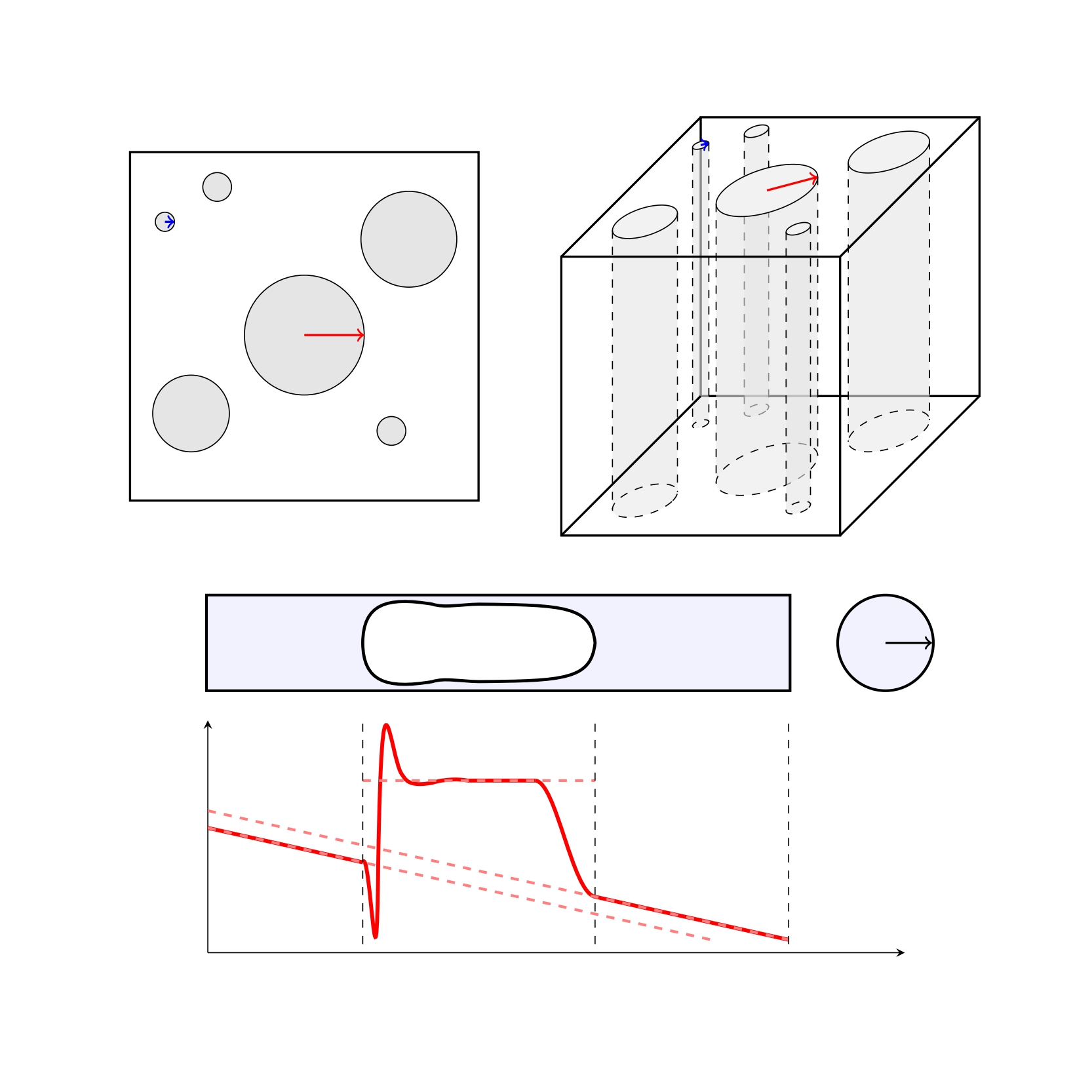
Bubble trains flowing through a capillary bundle
[3]

Convective heat transfer in the thin film of an elongated bubble in the absence of phase change

P. Botticini, D. Picchi, P. Poesio

Physical Review Fluids, 11(6): 063602 · 2026

DOI: 10.1103/tf8n-pmmb
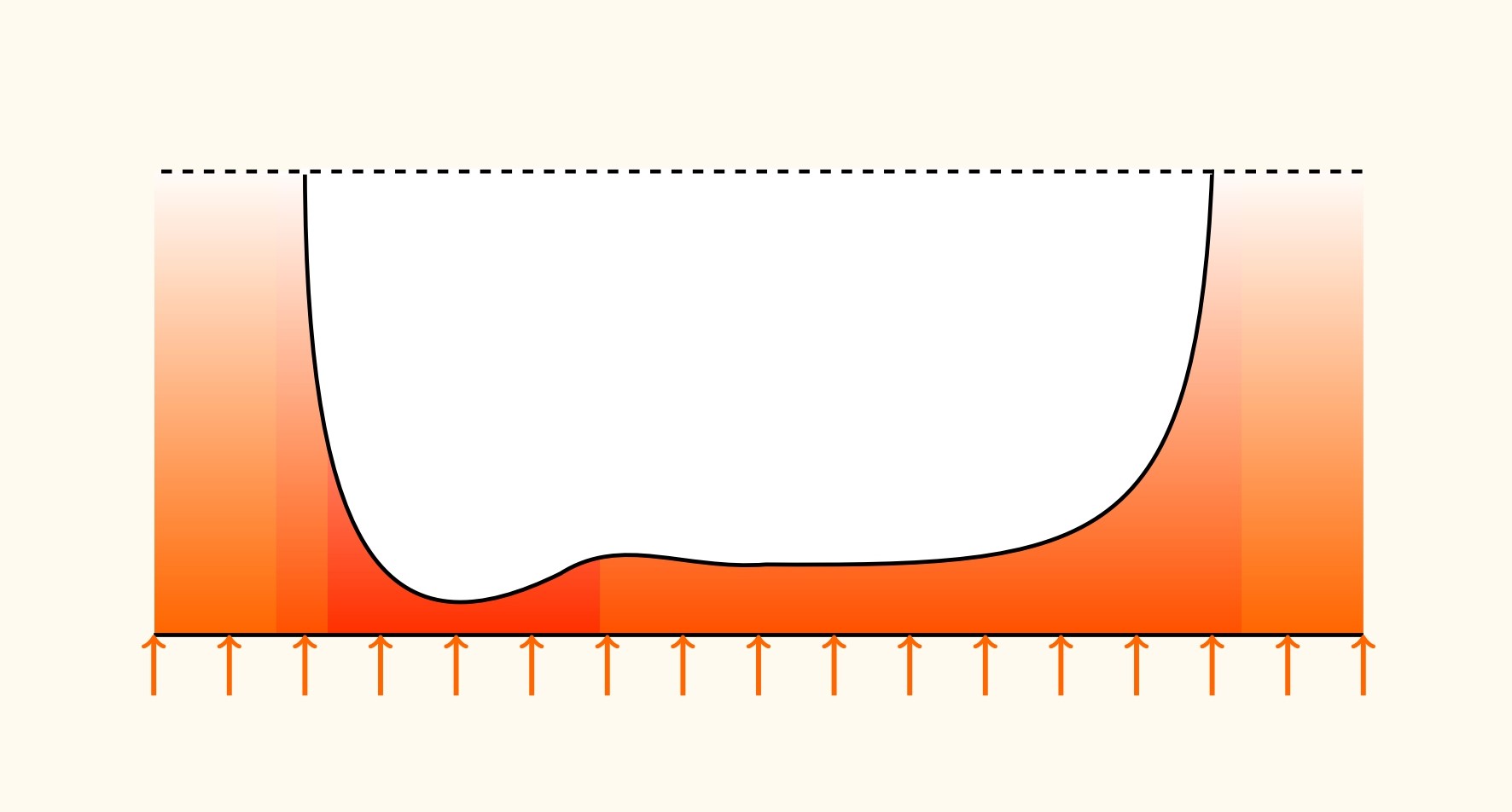
The injection of an elongated bubble into a microchannel is a well-established strategy for enhancing convective heat transfer, with applications ranging from electronics cooling to miniaturized heat exchangers. So far, a rigorous characterization of the heat removal capabilities of elongated bubbles (also known as Bretherton's or Taylor's bubbles) is still lacking. To address this gap, we investigate the forced convection problem in the thin film formed by an elongated bubble under uniform wall heat flux, examining the competition between advection, diffusion, viscous dissipation, and an imposed heat flux at the channel walls. By means of two-scale asymptotic analysis, we derive a one-dimensional advection-diffusion–heat-transfer equation with shape-dependent effective coefficients. This model generalizes the classical Graetz problem to capillary-driven flows and extends the Aris-Taylor dispersion to the case of an elongated bubble, clarifying the interplay between the imposed heat flux and the recirculating flow patterns at both front and rear menisci. Interestingly, the model recovers the Péclet-squared scaling of the effective diffusion coefficient and can be used to determine the heat transfer coefficient in the film region. In fact, we derive a closed-form scaling law for the Nusselt number, revealing the influence of the problem parameters (i.e., the bubble profile and the axial temperature gradient) and the dimensionless groups (Péclet, Brinkman, and capillary numbers) on forced convection. Grounded in first principles, our analysis contributes to a deeper understanding of capillary-driven forced convection in confined environments.
Thermal dispersion in the thin film around a bubble under isoflux conditions at the wall

2025

[2]

Forced convection in two-phase core-annular flows

P. Botticini, D. Picchi, P. Poesio

Journal of Fluid Mechanics, 1011: A41 · 2025

DOI: 10.1017/jfm.2025.360
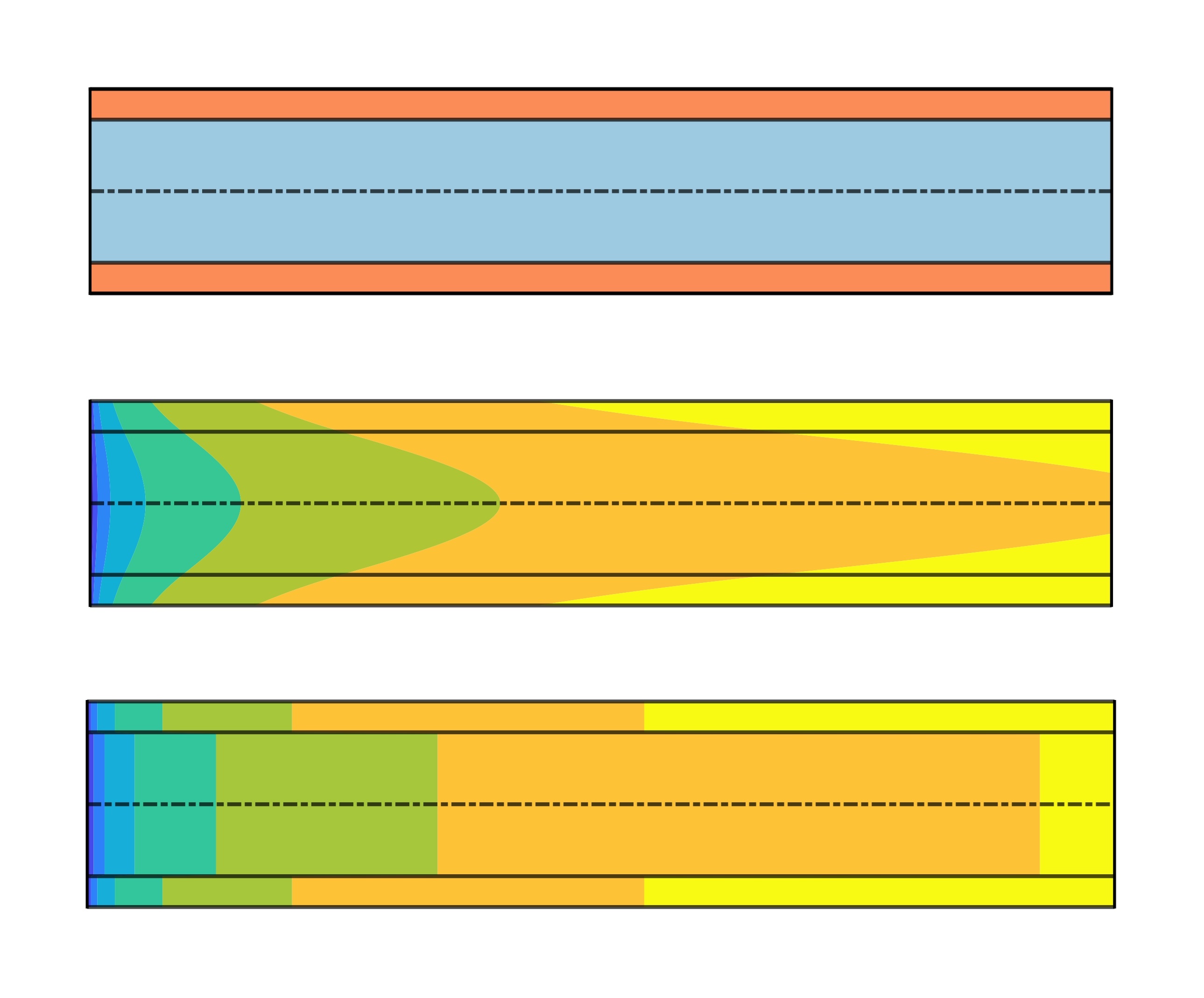
Predicting the temperature distribution in laminar two-phase flows is essential in a wide range of engineering applications, like heat dissipation of electronic equipment and thermal design of biological reactors. Motivated by this, we extend the classical Graetz problem, studying the heat transfer between two flowing phases in a core-annular flow configuration. Using a rigorous two-scale asymptotic analysis, we derived two coupled one-dimensional advection–diffusion heat-transfer equations (one for each phase) embedding the effects of advection, diffusion (both axial and transverse) and viscous dissipation. Specifically, the heat-transfer mechanisms are described through effective velocity and effective diffusion coefficients, while the interaction between the phases is accounted for via ad hoc coupling and source terms, respectively. The dynamics of the problem is controlled by seven dimensionless groups: the Péclet and Brinkman numbers, the heat flux, the viscosity, thermal diffusivity and thermal conductivity ratios, and the volume fraction. Our analysis reveals the existence of two main regimes, depending on the disparity in thermal conductivity between the phases. When the conductivity ratio is of order one, the problem is strongly coupled; otherwise, the phases are thermally decoupled. Interestingly, we investigate the evolution of the heat-transfer coefficient in the thin-film limit, shedding light on the most common assumptions underlying extensively used models in the context of film flows. Finally, we derived closed-form scaling laws for the Nusselt number clarifying the impact of the phases topology on heat-transfer dynamics. Since our model has been derived by first principles, we hope that it will improve the understanding of two-phase forced convection.
Two-scale asymptotics in core-annular flow

2024

[1]

Compressibility-induced destabilisation of falling liquid films: an integral approach

P. Botticini, G. Lavalle, D. Picchi, P. Poesio

International Journal of Multiphase Flow, 171: 104667 · 2024

DOI: 10.1016/j.ijmultiphaseflow.2023.104667
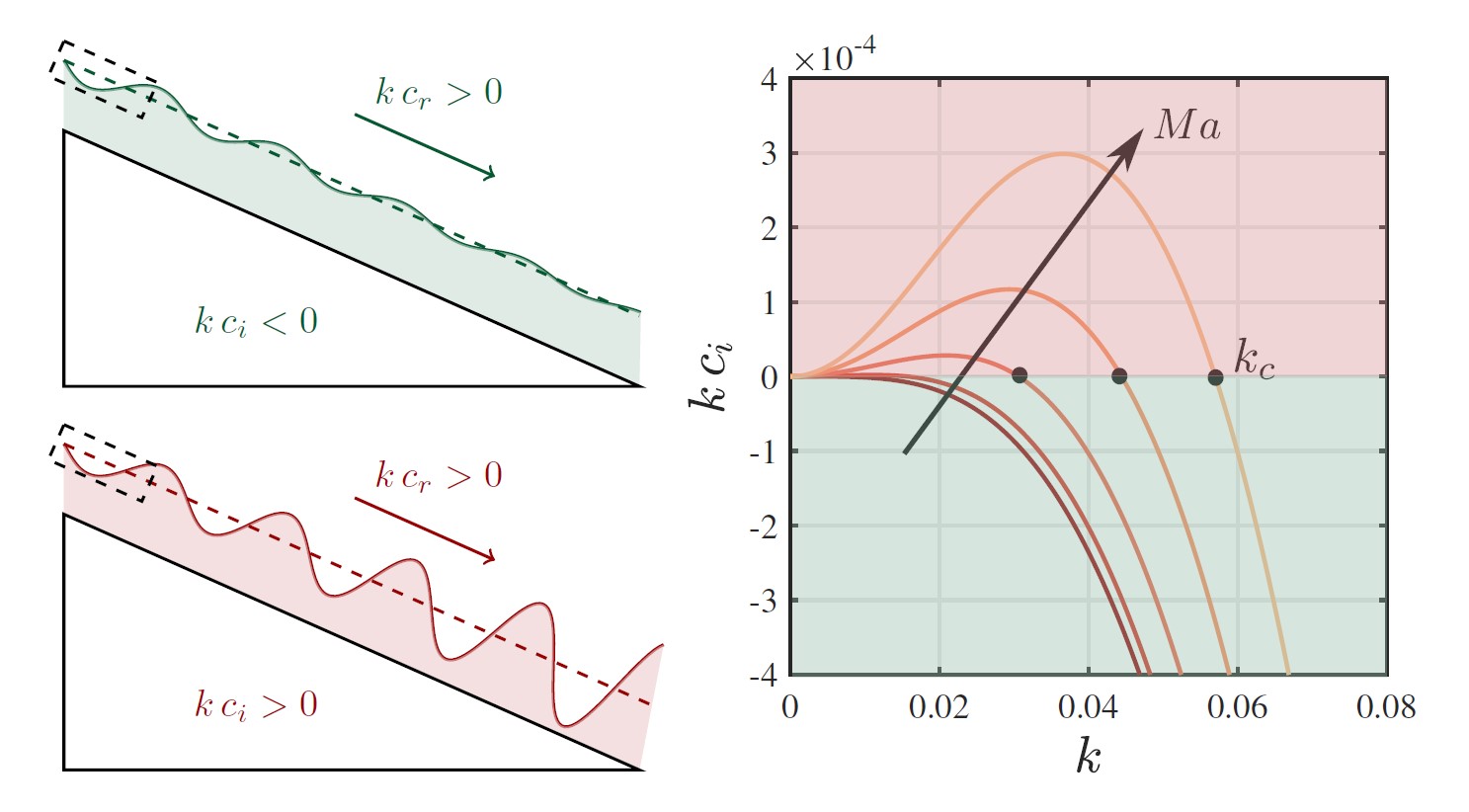
We revisit the classical 2D problem of a gravity-driven liquid layer down an inclined plate (Kapitza, 1948), relaxing the usual assumption of homogeneous fluid. We set out to answer three major issues. When the fluid density is allowed to vary, (i) how does this feature structurally affect the formulation of a low-dimensional depth-averaged model? (ii) To what extent and (iii) by virtue of which physical mechanism does compressibility participate in the long-wave interfacial instability? To provide the relevant answers, (i) we first make use of a second-order asymptotic expansion in the shallowness parameter to develop a weakly-compressible boundary-layer system: starting from a two-equation momentum-integrated model, an additional barotropic equation of state is required for closure purposes. In this respect, (ii) a temporal linear stability analysis is performed: it is revealed that compressibility plays a destabilising role whose magnitude is enhanced at intermediately tilted configurations, and the more the Reynolds number approaches the critical threshold in the incompressible limit. (iii) We finally interpret the ensuing dispersion relation under the convenient framework of two-wave hierarchy, initiated by Whitham (1974): the primary instability gets promoted by the flow compressibility as it contributes to deceleration of dynamic waves most significantly in the low-inertia regime. Indeed, compressibility locally acts as a further boost to the inertia-based mechanism of Kapitza instability by amplifying flow-rate variations within the liquid film.
Linear stability analysis of a weakly-compressible falling film